


TL;DR:
- Listing vacation rentals on multiple platforms with optimized descriptions and professional photos maximizes revenue opportunities. Utilizing channel managers and directly offering booking websites helps expand exposure, reduce fees, and build guest loyalty. Effective hosting depends on timely responses, accurate listings, and ongoing optimization of marketing strategies.
Listing vacation rentals online is the single most direct path to turning your property into a consistent revenue stream. Platforms like Airbnb, Vrbo, Booking.com, and Google Vacation Rentals now give homeowners and investors access to millions of active travelers searching for exactly what you have. But knowing how to list vacation rentals online the right way, with optimized descriptions, professional photos, and smart platform choices, separates the hosts earning top dollar from those watching their calendars collect dust. This guide covers every step, from platform selection to multi-channel management, so your listing works as hard as you do.
Which vacation rental platforms should you list on and why
The short-term rental (STR) market runs on a handful of major online travel agencies (OTAs), and your choice of platform directly shapes who finds your property and how much commission you pay.
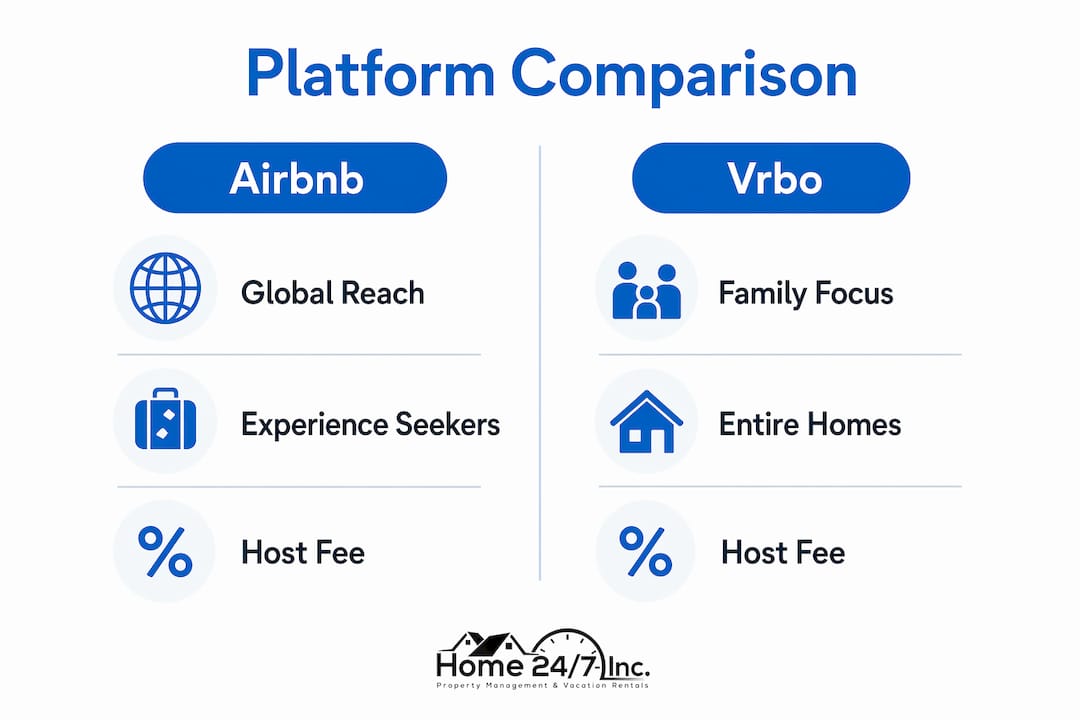
Comparing the major platforms
| Platform | Audience strength | Host fee | Best for |
|---|---|---|---|
| Airbnb | Global, experience-seekers | 3% host fee | First-time hosts, unique properties |
| Vrbo | Families, longer stays | 5% per booking | Whole-home rentals |
| Booking.com | International travelers | 15-18% commission | High-volume urban or resort markets |
| Google Vacation Rentals | Search-driven discovery | Varies by integration | Direct booking amplification |
Airbnb dominates global reach and works well for most property types. Vrbo skews toward family groups booking entire homes for a week or more, which means higher average booking values. Booking.com pulls heavy international traffic but takes a larger cut. Google Vacation Rentals is not a standalone booking platform. It surfaces your property directly in Google Search results, which makes it a powerful amplifier for direct booking websites.
Listing exclusively on one platform feels safe, but it caps your exposure. Multi-platform listing combined with channel managers and property management systems (PMS) increases booking exposure while reducing double-booking risks. The tradeoff is operational complexity, which is where channel managers like Guesty, Hostaway, or Lodgify earn their keep by syncing calendars and rates across every platform automatically.
Direct booking websites deserve a mention here. Direct booking integration with Google Vacation Rentals reduces commission fees by 3 to 15% and builds long-term guest relationships because you own the guest data. Over time, repeat guests who book direct are worth significantly more than one-time OTA visitors.
How to craft a vacation rental listing that drives bookings
A high-performing listing is not a property brochure. It is a conversion tool built around what your guest wants to feel, not just what your property has.

Writing titles that get clicked
Airbnb titles perform best at around 50 characters using a structure of distinctive feature plus location signal plus guest experience hook. “Waterfront Pool Home | Cape Coral | Sunset Views” tells a guest exactly what they are getting in one glance. Keyword stuffing like “3BR 2BA House Near Beach Pool WiFi” reads like a classified ad and converts poorly. Think of your title as a movie trailer: tease the best part, make them want more.
Descriptions that sell the experience
Descriptions between 150 and 300 words see the highest guest engagement. Go above 350 words and eyes start glazing over. Drop below 150 and you lose the conversion detail that turns browsers into bookers. Write from the guest’s perspective, not the host’s. Instead of “the kitchen has stainless steel appliances,” try “cook a fresh catch from the marina in a fully equipped kitchen while the kids splash in the pool.” Sensory and emotional language drives higher booking rates because guests are buying an experience, not square footage.
Photography: your single biggest lever
Professional vacation rental photography correlates with 20 to 35% more revenue and 60% more listing views compared to amateur photos. That is not a small edge. That is the difference between a full calendar and a half-empty one. The optimal range is 15 to 30 high-quality images. Interest drops sharply below 15, and gains flatten out above 30. If a full reshoot is not in the budget right now, reordering your existing photos to lead with the most compelling shots can increase conversion by 6 to 10% on entertainment-forward properties. Start with the pool, the view, or the living room, not the hallway.
Amenity tags and pricing strategy
Untagged amenities cause listings to disappear from filtered searches entirely. A guest searching for “air conditioning + workspace + pool” will never see your property if those features are not explicitly tagged in the platform’s amenity system, even if your description mentions them. Tag everything, including the obvious stuff. For pricing, new listings that sit within 10 to 15% of the local market median perform better out of the gate. Offering 20% off your first three bookings accelerates calendar fills by roughly 30% and generates the early reviews that push your ranking up fast.
Pro Tip: Enable Instant Book with government ID verification and a positive review history requirement. Instant Book listings receive 35% more reservations, and the ID requirement keeps the risk manageable.
How to list and manage vacation rentals on multiple sites
Expanding to multiple platforms is one of the smartest moves you can make for maximizing rental income, but it requires a system. Without one, you are one double-booking away from a very bad review and a very awkward phone call.
Here is a practical approach to multi-platform management:
- Start with two platforms. Launch on Airbnb and Vrbo first. Get your systems dialed in before adding Booking.com or a direct site.
- Set up a channel manager immediately. Tools like Guesty, Hostaway, or Lodgify sync your availability calendar across every platform in real time. This is non-negotiable once you list on more than one site.
- Standardize your listing content. Use the same core description, photo set, and amenity list across platforms. Inconsistent messaging confuses guests and signals unprofessionalism.
- Automate your response workflow. A response rate below 90% within 24 hours penalizes your search ranking on Airbnb. Sub-one-hour reply times correlate with 25% higher booking conversion. Automated acknowledgment messages handle the gap without you staring at your phone all day.
- Review pricing weekly. Market rates shift with seasons, local events, and competitor moves. Frequent pricing reviews keep you competitive without leaving money on the table.
Pro Tip: Keeping calendars current across all platforms is one of the most underrated operational edges in short-term rental hosting. A stale calendar leads to double bookings, cancellations, and ranking penalties that take weeks to recover from.
The payoff for getting this right is real. Properties listed across Airbnb, Vrbo, Booking.com, and Google Vacation Rentals consistently reach the widest possible audience. More eyeballs, more bookings, more revenue.
What are the most common listing mistakes and how do you fix them
Most underperforming listings share the same handful of problems. The good news is that every one of them is fixable.
- Writing for yourself, not your guest. Hosts describe what they love about the property. Guests want to know how it will make them feel. Reframe every sentence around the guest’s experience.
- Too few photos. Listings with fewer than 15 images see a sharp drop in interest. If your listing has 8 photos, adding 7 more is probably the fastest ROI move available to you right now.
- Missing amenity tags. As noted above, untagged amenities make your listing invisible in filtered searches. Go through every amenity your property offers and tag it explicitly in the platform dashboard.
- Ignoring reviews and response rates. Reviews are ranking fuel. A property with 50 reviews at 4.8 stars will almost always outrank a newer listing with better photos. Respond to every review, positive or negative, and treat guest communication like a sport you are trying to win.
- Unclear or surprise fees. Guests abandon bookings when cleaning fees or service charges appear at checkout and feel disproportionate. Be transparent about your fee structure in the listing itself.
“The best listings read like a letter from a friend who happens to own the perfect vacation home. They are warm, specific, and make you feel like you are already there.”
Checking your guest amenity presentation against what top-performing properties in your market offer is a fast way to spot gaps you might not have noticed.
Key takeaways
A well-optimized vacation rental listing on the right platforms, with professional photos and guest-focused copy, is the foundation of consistent rental income.
| Point | Details |
|---|---|
| Platform selection matters | List on Airbnb, Vrbo, and Booking.com to maximize reach; add a direct booking site to reduce commission costs. |
| Photos drive revenue | Professional photography increases views by 60% and revenue by up to 35%; use 15 to 30 images minimum. |
| Descriptions need a guest lens | Write 150 to 300 words focused on guest experience, not property specs, for highest engagement. |
| Multi-platform needs a system | Use a channel manager like Guesty or Hostaway to sync calendars and avoid double bookings. |
| Response speed affects ranking | Reply within one hour to boost conversion by 25% and protect your search ranking across platforms. |
What I have learned from years of listing optimization
I will be straight with you: most hosts spend 80% of their energy on the wrong things. They agonize over throw pillow colors and ignore the fact that their listing title reads like a tax form. The single biggest shift I have seen in listing performance comes from treating the listing itself as a marketing asset, not an admin task.
The hosts who consistently outperform their market are not necessarily the ones with the nicest properties. They are the ones who update their pricing every week, respond to inquiries within minutes, and write descriptions that make you feel the warm Gulf breeze before you have even clicked “Book.” That specificity is what converts a browser into a guest.
One thing the data confirms but most hosts resist: direct booking channels are worth the setup effort. Yes, building a direct booking website takes time. But reducing your OTA dependency by even 20% compounds into serious margin improvement over a full year. Pair that with Google Vacation Rentals integration and you are capturing search-intent traffic that your competitors are leaving on the table.
The other thing I would push back on is the idea that more platforms always means more work. With the right channel manager in place, adding a third or fourth platform is genuinely low-effort. The incremental bookings from Booking.com or a direct site can fill the gaps that Airbnb alone leaves open, especially during shoulder seasons. For a deeper look at off-season rental strategies, that is where multi-platform presence really pays off.
— Philipp
Let Home24seven handle your listings while you enjoy the returns
Getting your listing right is one thing. Keeping it optimized across multiple platforms, responding to guests at 11 PM, coordinating cleaners between same-day turnovers, and adjusting pricing for a Cape Coral fishing tournament you did not know was happening — that is a full-time job.
Home24seven has been managing vacation rentals in Cape Coral since 2017, and we handle all of it. Professional photography coordination, multi-platform listing setup, calendar synchronization, guest communication, and revenue optimization are all part of what we do. If you want your property earning at its full potential without the operational headache, our property management services are built exactly for that. Reach out and let’s talk about what your property could be earning.
FAQ
What are the best sites for vacation rentals in 2026?
Airbnb, Vrbo, and Booking.com are the top three platforms by traffic and booking volume. Adding a direct booking website integrated with Google Vacation Rentals reduces commission fees by 3 to 15% and builds long-term guest relationships.
How many photos should a vacation rental listing have?
The optimal range is 15 to 30 high-quality images. Listings with fewer than 15 photos see a sharp drop in interest, while adding more than 30 produces diminishing returns.
Does Instant Book really increase bookings?
Yes. Instant Book enabled listings receive 35% more reservations. You can require government ID verification and a positive review history to reduce guest risk while keeping the booking advantage.
How do I avoid double bookings on multiple platforms?
Use a channel manager like Guesty, Hostaway, or Lodgify to sync your availability calendar across all platforms in real time. Manual calendar updates are too slow and too error-prone once you list on more than one site.
How long should a vacation rental description be?
Descriptions between 150 and 300 words see the highest guest engagement. Focus on the guest experience using sensory and emotional language rather than listing property features in a dry, spec-sheet format.

